Estate Planning Attorney in Columbia, SC
Richland County estate planning, done online: wills, living trusts, healthcare directives, and powers of attorney — without the office visit.
Protecting your family starts with the right documents
Estate planning for Columbia households is less about templates and more about three questions: who inherits, who acts for you if you can't, and whether Richland County probate is worth avoiding. A do-nothing default answers all three with South Carolina intestacy — a fixed statutory formula that rarely matches what families actually want.
For most Columbia clients the working set is a will, a durable financial power of attorney, a healthcare power of attorney with a living will, and (when there's real estate, a blended family, or young children) a revocable living trust. Beneficiary forms on retirement accounts and life insurance are coordinated alongside — otherwise the will and the beneficiary form contradict each other.
Ryan handles every Columbia engagement personally, on Zoom, on a flat fee quoted before any work starts. No paralegals, no associates, no in-person trips.
SC intestacy: SC intestacy under Title 62 divides the estate by formula, not by what the deceased actually wanted. Spouse takes one-half; descendants take one-half. Step-children and unmarried partners are outside the statutory line.

Estate planning for Columbia residents
Columbia is South Carolina's state capital and a different estate planning market from coastal SC. The defining demographics here are public sector: state government employees (a substantial portion of Richland County's workforce), USC (University of South Carolina) faculty and staff, Fort Jackson military families (the largest U.S. Army training installation), Prisma Health (formerly Palmetto Health) physicians and staff, and the surrounding judicial, legal, and lobbying ecosystem that orbits state government. Median home values are notably lower than Charleston or Bluffton — but median estates often include defined-benefit pensions and TSP/401(k) accounts that create planning needs different from coastal SC's real-estate-heavy estates.
Columbia estate planning concerns reflect this demographic mix. State retirement system benefits (SCRS, PORS for police/firefighters, ORP for university faculty) require specific beneficiary coordination — and a will alone cannot redirect them. Military families at Fort Jackson have multi-state domicile complexity and military-specific benefits (SBP, VA, TSP). USC faculty have ORP elections with different distribution rules than the SCRS pension. The Prisma Health system has specific physician and staff retirement plans that need coordination.
Ryan handles Columbia engagements with attention to public-sector retirement planning, military family multi-state issues, USC ORP coordination, Fort Jackson SCRA protections, and the standard SC trust and probate planning that benefits all Columbia families regardless of employer.
Common situations we see in Columbia
Estate planning needs are not generic. These are the specific scenarios Columbia clients bring to us — and how a well-drafted plan answers each one.
Columbia neighborhoods and communities
Ryan serves clients across Columbia and Richland County — all virtually, with no office visit required.
South Carolina requirements every Columbia resident should know
Columbia planning works under four SC frameworks: will execution under S.C. Code § 62-2-502 (no handwritten/unwitnessed wills), the SC Uniform Power of Attorney Act (§§ 62-8-101 et seq.; notary plus two witnesses), the Healthcare Power of Attorney and Death with Dignity Act (§§ 44-77-10 et seq.; the two witnesses cannot be related to you or share in your estate), and the SC Uniform Trust Code (Title 62, Chapter 7).
Without a financial power of attorney, family members petition Richland County Probate Court for a conservatorship — expensive and slow. Full statute references: South Carolina estate planning guide.
USC Faculty, Fort Jackson Cycles, and the SC Bar Legal Community
Columbia’s estate planning conversations are shaped by three institutional populations that meet nowhere else in South Carolina: the academic and athletic complex of the University of South Carolina, the rotating training cycle at Fort Jackson, and the state bar concentrated within walking distance of the Supreme Court of South Carolina and the General Assembly.
Fort Jackson Training Cycles and Soldier Planning
Fort Jackson processes more Basic Combat Training soldiers than any other Army installation. The base also houses permanent-party drill sergeants, cadre, and their families. From a planning standpoint, the training cycle creates predictable windows during which soldiers and their dependents have limited ability to execute or update legal documents. Effective planning before deployment or PCS includes:
- A Servicemembers Civil Relief Act-aware durable power of attorney recognizing the SCRA protections at 50 U.S.C. § 3901 et seq. for default judgments, lease termination, and interest-rate caps.
- SGLI beneficiary designations updated to match the current estate plan. Servicemembers’ Group Life Insurance proceeds pass by beneficiary designation, not by will, and outdated designations are a leading source of post-deployment litigation.
- A South Carolina Health Care Power of Attorney under S.C. Code § 62-5-501 et seq., naming both a primary agent (typically the spouse) and a successor agent who can act if the spouse is also a servicemember subject to deployment.
- Guardianship designations under S.C. Code § 62-5-202 for minor children of dual-military families, with clear standby provisions for both parents’ simultaneous deployment.
USC Faculty and Athletics Planning
University of South Carolina faculty and athletic staff share many of the same planning issues as their UNC counterparts: TIAA-heavy retirement portfolios, IP royalty streams, and adult children scattered across multiple states. The South Carolina Retirement System (SCRS) and the Optional Retirement Program offered to USC faculty differ in succession treatment. The defined-benefit SCRS pays a survivor annuity only if the member elected a joint-and-survivor option at retirement under S.C. Code § 9-1-1620; the defined-contribution ORP passes by beneficiary designation like any IRA.
USC’s athletic staff and any participating student-athletes now navigate NIL revenue under South Carolina’s NIL law and NCAA rules. NIL income flowing to an LLC formed by a student-athlete is taxable income, and the LLC structure should be reviewed before the student graduates or transfers to ensure successor ownership is in place.
Planning for South Carolina Attorneys
Columbia’s legal community includes many sole practitioners and small-firm attorneys whose practices are themselves significant probate assets. South Carolina Rule of Professional Conduct 1.17 governs the sale of a law practice, and the Supreme Court’s administrative orders address the appointment of an attorney to protect client files when a sole practitioner dies or becomes incapacitated. A planning document specific to attorneys — a “practice transition plan” identifying a successor attorney, a file custodian, and trust-account signatories — is increasingly considered a professional responsibility obligation rather than a courtesy.
Estate planning services for Columbia families
Every plan is customized to your family, your assets, and South Carolina law — never a one-size-fits-all template.
A statute-compliant South Carolina will: who inherits, who acts as executor, who raises the children. Drafted to survive a Richland clerk's review.
Avoid Richland County probate. Trust-based plans keep the estate private and the timeline measured in weeks, not months.
Authorize a trusted person to handle finances and medical decisions if you can't — before a hospital or bank is the one asking.
A SC statutory advance directive — binding on hospitals and clear enough that the family is not improvising.
Transparent flat fees for Columbia households — quoted before any work begins, no hourly billing.
Specific provisions for digital assets so executors can actually access accounts under the South Carolina Revised Uniform Fiduciary Access to Digital Assets Act.
What happens without an estate plan in Columbia
Understanding the local probate process is one of the strongest reasons to plan ahead.
Probate is the court-supervised process of paying debts and transferring what the deceased owned. For Columbia estates without a trust, that means filing the will with Richland County Probate Court, qualifying a personal representative under S.C. Code Title 62, publishing notice to creditors, inventorying assets, and obtaining the court's approval before distribution. Timeline: 6–18 months, sometimes longer.
⚖ Richland County Probate — Key Facts
- Court: Richland County Probate Court
- Address: 1701 Main St, Columbia, SC 29201
- Filing fee: Determined by estate value under S.C. Code § 62-3-720
- Process: Open via informal probate where possible (S.C. Code § 62-3-301), publish creditor notice, settle the estate under court supervision
- How to avoid it: A funded revocable trust; beneficiary designations on retirement, life insurance, and POD/TOD bank accounts; joint tenancy with right of survivorship
- Richland County Probate Court: 1701 Main St, Columbia SC — handles all Richland County estate administration; the probate judge is a full-time position handling significant volume
- State Retirement Coordination: Many Columbia estates involve SC State Retirement System benefits (SCRS, PORS, ORP) that pass by beneficiary designation rather than through probate
- Military Considerations: Fort Jackson military families generate estates with multi-state asset components, requiring SC-only or coordinated multi-state administration depending on domicile
- Processing Time: Routine Richland County estate administration typically takes 9–13 months; matters with significant out-of-state assets or contested issues can extend longer
For Columbia families who want to keep Richland County Probate Court out of the picture, a funded revocable trust is the standard answer. Ryan drafts compliant with South Carolina's trust code, including the loyalty and prudence standards at S.C. Code §§ 62-7-802 / 62-7-804, and handles the trust funding (deed, retitling, beneficiary forms) before the engagement ends.
How Columbia families complete their estate plan
From first call to signed documents: typically 2–3 weeks, all remote.
Discovery Call
A free 30-minute Zoom that establishes the household assets, family structure, and goals — you leave with a clear scope and a quoted flat fee.
Drafting Phase
5–10 business days to produce SC-statute-compliant drafts of every document in your plan. Ryan does the drafting personally.
Document Execution
Final video call — review, witness, notarize, sign. RON-executed originals delivered as tamper-evident PDFs, valid statewide.
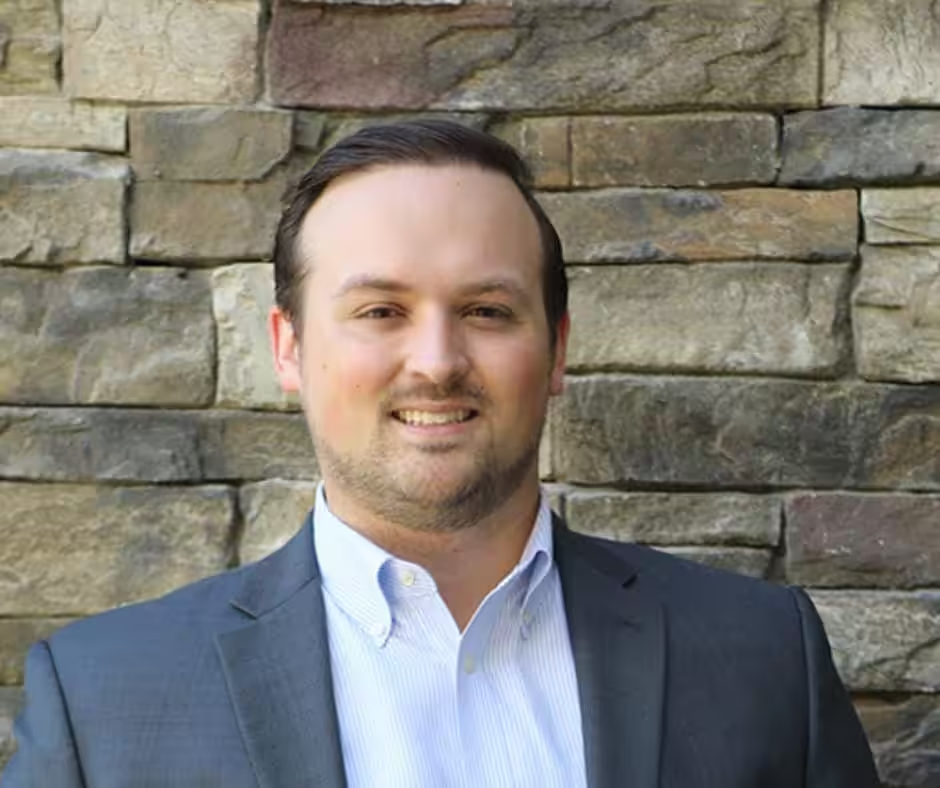
Ryan P. Duffy, Esq.
Ryan handles every Columbia engagement personally — no paralegals, no associates, no hand-offs. He founded Estate Planning of the Carolinas to make professional planning accessible to South Carolina families through a fully virtual practice.
Estate planning FAQ for Columbia, SC
South Carolina areas near Columbia
The practice is statewide and entirely remote. These communities are within easy reach of Columbia.
Make the plan official — from your Columbia living room
Start with a free 30-minute consultation. No office visit, no hourly billing — clear guidance from a licensed South Carolina estate planning attorney.