Estate Planning Attorney in Durham, NC
Durham County estate planning, done online: wills, living trusts, healthcare directives, and powers of attorney — without the office visit.
Protecting your family starts with the right documents
If you live in Durham and die without a will — legally “intestate” — North Carolina law decides who inherits, who raises your children, and who manages your affairs. That choice belongs to the state unless you make it yourself.
A working Durham plan usually combines four documents: a Last Will and Testament, a Durable Power of Attorney, a Healthcare Power of Attorney, and a Living Will. Households with real estate, blended families, or minor children often add a Revocable Living Trust to keep the estate out of Durham County probate.
Ryan P. Duffy works with Durham families entirely by Zoom — documents drafted, reviewed, and signed under Remote Online Notarization. Flat fees, no hourly billing, no office visits.
NC intestacy: When a Durham resident dies without a will, N.C.G.S. §§ 29-1 through 29-30 control the result — not the family. The shares are mechanical: spouse + children, spouse + parents, descendants alone, and so on. Stepchildren and unmarried partners receive nothing.

Estate planning for Durham residents
Durham is the Triangle's intellectual and medical hub — home to Duke University, the Duke Health System, the Eshelman School of Pharmacy programs, and one of the densest concentrations of life science and biotech employers in the Southeast. Add the western edge of Research Triangle Park, and Durham's working population skews heavily toward academics, physicians, biotech researchers, and tech professionals — each group with estate planning needs that don't fit a generic template.
Durham also carries a unique historical and demographic context. The Hayti and Black Wall Street legacy means many Durham families have multi-generational property holdings and family-owned business legacies that require thoughtful succession planning. Newer Durham residents — drawn by Duke, RTP, and the city's revitalized downtown — often arrive with significant out-of-state retirement accounts, university-specific retirement plan structures (TIAA/CREF, Duke's defined contribution plans), and equity in pre-IPO biotech or tech ventures.
Ryan handles Durham engagements with attention to these realities: Duke faculty plan elections, Duke Health physician practice equity, biotech IP and royalty interests, and the multi-generational legacy planning that Durham's long-established families require. Trust-based planning is particularly valuable here — Durham County probate is competent but slow for complex estates, and trust administration bypasses the process entirely.
Common situations we see in Durham
Most Durham families fall into one of these patterns. The drafting answer is different for each.
Durham neighborhoods and communities
Ryan serves clients across Durham and Durham County — all virtually, with no office visit required.
North Carolina requirements every Durham resident should know
North Carolina recognizes attested wills under N.C.G.S. § 31-3.3 (in writing, signed, two witnesses) and holographic wills, though holographic wills are easier to contest. A self-proving affidavit under N.C.G.S. § 31-11.6 lets the Durham clerk admit the will without later witness testimony. Powers of attorney follow the NC Uniform Power of Attorney Act (Chapter 32C); healthcare directives follow the Natural Death Act (N.C.G.S. Chapter 90). Revocable living trusts are governed by the NC Uniform Trust Code (Chapter 36C) and bypass Durham County Clerk of Superior Court if properly funded.
For citations and the full statutory framework, see the North Carolina estate planning guide.
Hayti and Multi-Generational Black Wall Street Planning
Durham’s Hayti neighborhood and the Parrish Street “Black Wall Street” corridor represent one of the most consequential concentrations of African American wealth-building in the South. Many parcels in and around Fayetteville Street, the old Hayti business district, and adjacent neighborhoods like Walltown and West End have been passed down informally since the early twentieth century. The result, decades later, is a recurring planning problem: heirs’ property held by ten, twenty, or thirty cousins as tenants in common, with no clear title and no agreed plan for what to do with it.
The legal mechanics matter. When a Durham homeowner dies intestate, N.C.G.S. § 29-15 distributes the real property among descendants as undivided fractional interests. Each generation that passes without a probate or a deed of distribution multiplies the number of owners and shrinks each share. By the third generation, a single Hayti lot may have fifty record owners scattered across North Carolina, New York, and California, many of whom have never set foot on the property. Any one of them can, under longstanding partition law, force a sale.
The Uniform Partition of Heirs Property Act
North Carolina adopted the Uniform Partition of Heirs Property Act, codified at N.C.G.S. § 46A-71 through § 46A-85, in 2009. The Act adds critical protections before a court can order a partition sale of qualifying heirs’ property: court-ordered appraisal at fair market value, a right of first refusal for cotenants to buy out the petitioning interest, and a strong statutory preference for partition in kind over forced sale. For Durham families holding Hayti-area property, invoking the Act early — ideally before any cotenant files for partition — can preserve generational ownership that would otherwise be lost to a single disgruntled cousin and a tax-deed speculator.
Practical planning steps for multi-generational Durham families include:
- Title cleanup: Order a full chain-of-title search back to the original deed, identify every living heir, and either obtain quitclaim deeds or quiet-title the parcel before any sale or refinance.
- Family LLC or tenancy agreement: Once title is consolidated, move ownership into a North Carolina LLC governed by an operating agreement that addresses buy-sell terms, voting on improvements, and rental income distribution. This converts unmanageable cotenancy into governable membership interests.
- Revocable trusts for each branch: Each family branch can place its LLC membership into a revocable trust, avoiding probate at each death and keeping the ownership structure stable through generations.
- Conservation or historic designation: Some Hayti-area parcels qualify for historic preservation tax credits under N.C.G.S. § 105-129.105, which can fund rehabilitation while preserving family ownership.
The cost of doing nothing is rarely zero. Property tax delinquencies on heirs’ property frequently end in tax foreclosure under N.C.G.S. § 105-374, which extinguishes every cotenant’s interest regardless of whether they received notice. A modest investment in title and structure today protects a century of family equity tomorrow.
Estate planning services for Durham families
Every plan is customized to your family, your assets, and North Carolina law — never a one-size-fits-all template.
A North Carolina-statute-compliant will: distribution scheme, executor, guardianship, and the self-proving affidavit Durham wants to see.
A funded revocable trust under NC law moves real estate, accounts, and business interests to heirs without Durham probate supervision.
Two short documents that prevent a Durham guardianship or conservatorship case if you lose capacity.
A living will under NC law gives a binding answer when no one in the room knows what you would have chosen.
Document bundles or full plans — Durham clients see the full cost before signing the engagement letter.
Cryptocurrency, brokerage logins, business accounts, and digital assets — covered under NC law.
What happens without an estate plan in Durham
Understanding the local probate process is one of the strongest reasons to plan ahead.
A Durham resident who dies without a funded living trust ends up in front of the Durham County Clerk of Superior Court. NC executors have 60 days to file the will (N.C.G.S. § 28A-2A-1), and creditor notice runs for the period set by N.C.G.S. § 28A-14-1. Total time: typically 6–18 months, public record, supervised by the court.
⚖ Durham County Probate — Key Facts
- Court: Durham County Clerk of Superior Court
- Address: 201 E Main St, Durham, NC 27701
- Filing fee: Set by N.C.G.S. § 7A-307: a $120 minimum plus an ad valorem percentage of the estate
- Process: NC Chapter 28A: qualify, inventory, notice creditors for the statutory period, file annual or final accountings, distribute — supervised by the Durham clerk
- How to avoid it: A funded revocable trust avoids the whole process; beneficiary designations and TOD deeds handle pieces individually if a trust is overkill for the situation
- Durham County Justice Center: 510 S Dillard St — handles estate matters; the estates division typically schedules first appointments 3–5 weeks out
- Online Filing: Durham County participates in NC eCourts — most non-original filings can be submitted electronically
- Processing Time: Durham County probate moves at a moderate pace — typical estate administration takes 12–16 months, slower than smaller adjacent counties
- Cross-County Coordination: Durham residents who own property in Wake (Raleigh side) or Orange (Chapel Hill) may need ancillary proceedings — trust-based planning eliminates this
Trust-based planning is the standard Durham workaround for Durham County Clerk of Superior Court. Compliant drafting under the NC Uniform Trust Code (Chapter 36C) is necessary but not sufficient — the trust must actually be funded with real estate, accounts, and beneficiary designations. Ryan handles both pieces of the work.
How Durham families complete their estate plan
From first call to signed documents: typically 2–3 weeks, all remote.
Free Zoom Consultation
30–60 minutes by video. We cover assets, family structure, and the documents that actually fit — no pitch deck, no upsell.
Custom Drafting
Ryan personally drafts every document — no paralegal, no template — tailored to the assets and family structure discussed on the intake call.
Document Execution
Final video call — review, witness, notarize, sign. RON-executed originals delivered as tamper-evident PDFs, valid statewide.
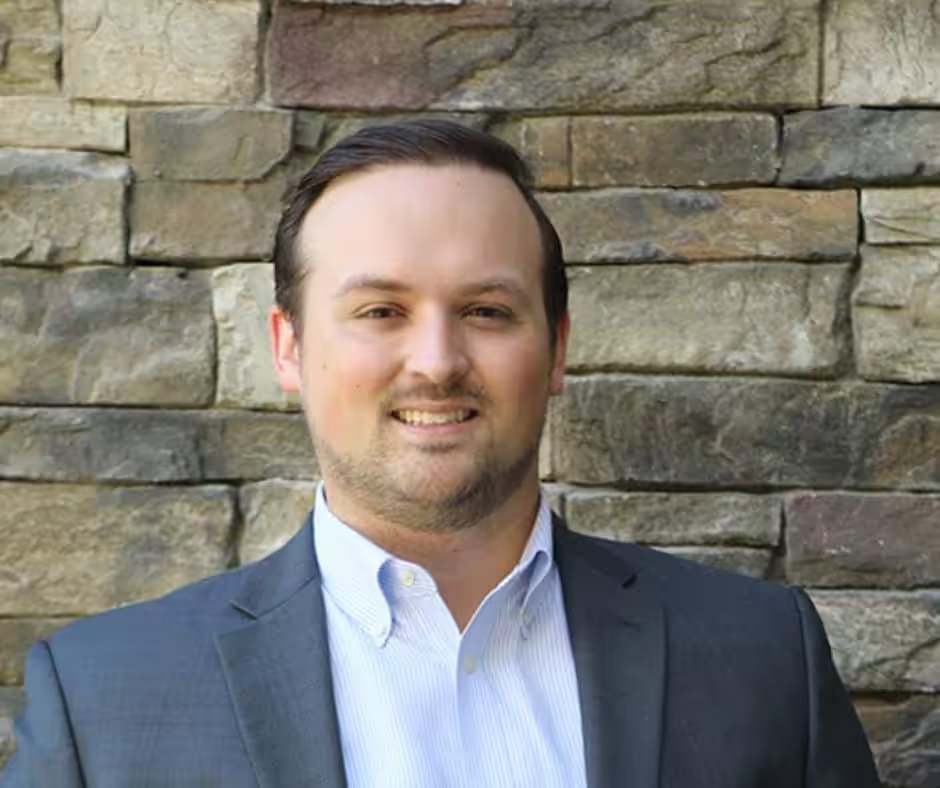
Ryan P. Duffy, Esq.
Durham clients work with Ryan directly from the intake call to the executed signature page. No associates, no hand-offs. The practice is built around accessible, flat-fee planning delivered remotely across North Carolina.
Estate planning FAQ for Durham, NC
North Carolina areas near Durham
The practice is statewide and entirely remote. These communities are within easy reach of Durham.
A Durham estate plan, finished in three weeks
A free intake call covers the planning questions specific to your household. No commitment, no office trip, no hourly billing.