North Carolina Estate Planning Attorney

Estate Planning Attorney in Raleigh, NC

Flat-fee wills, living trusts, and powers of attorney for Raleigh families — 100% virtual, no office visit required.

NC Licensed Attorney Flat-Fee Pricing ★ 5.0 Google Rating 100% Virtual • Zoom Consultations
Why Raleigh Families Need an Estate Plan

Protecting your family starts with the right documents

Raleigh families come to Estate Planning of the Carolinas for one reason: they want the planning done right, without the office visits and hourly bills that traditional NC firms still charge for. The work itself isn't mysterious. A will controls who inherits. A power of attorney lets a trusted person act if you can't. A healthcare power of attorney and living will put a known voice in the room when a hospital is asking who decides.

A revocable living trust comes in when Wake County probate is worth bypassing — common for families with real estate, business interests, or privacy concerns. Without those documents in place, North Carolina intestate succession decides for you and Wake County Clerk of Superior Court supervises the result, publicly, on the court's timeline.

Ryan drafts every plan personally, by Zoom, at a flat fee. Raleigh clients sign under Remote Online Notarization without leaving home.

NC intestacy: N.C.G.S. § 29-14 distributes an intestate estate by a fixed formula — in many Raleigh households the surviving spouse takes only the first $60,000 of personal property plus one-half of the remainder, with the rest passing to descendants. Unmarried partners take nothing.

Raleigh, North Carolina
Proudly serving Raleigh, NC
About Raleigh

Estate planning for Raleigh residents

The Research Triangle's legal and government hub

Raleigh is North Carolina's capital and the cornerstone of the Research Triangle — one of the most highly educated metropolitan areas in the country. Wake County is home to NC State University, the Research Triangle Park (RTP) tech corridor, and a substantial state government workforce. The result is an unusual mix of estate planning clients: tech professionals with significant stock options and 401(k)s, state employees with pensions and TSP-equivalent retirement plans, academics with TIAA/CREF accounts, and biotech professionals managing IP and royalty interests.

Raleigh's estate planning concerns reflect its demographics. NC Retirement Systems benefits (TSERS for state employees, LGERS for local government, ORP for university faculty) require specific beneficiary coordination — and a will alone cannot redirect these benefits, since they pass by designation. The Research Triangle's tech and biotech professionals often have concentrated equity in startups, late-stage private companies, or recently IPO'd firms — each requiring specific valuation, voting, and transfer provisions. Academic families at NCSU, Duke (in Durham), and UNC (in Chapel Hill) often face unique cross-institution retirement plan structures and intellectual property concerns.

Ryan has prepared plans for Raleigh state employees, RTP technology professionals, NCSU faculty, and Wake County medical professionals (WakeMed, Duke Raleigh, UNC Rex) — each with planning challenges specific to their employer ecosystem.

Local Estate Planning Scenarios

Common situations we see in Raleigh

Most Raleigh families fall into one of these patterns. The drafting answer is different for each.

🎓
NC State Government Employees
TSERS pension benefits, NC 401(k) Plan accounts, and supplemental retirement income require careful beneficiary designation review. Survivor benefit elections must be coordinated with your overall estate plan — a common gap in plans drafted without state-employee specifics in mind.
💻
Research Triangle Tech Professionals
Pre-IPO stock options, vesting schedules, and concentrated single-employer equity positions need anticipatory trust provisions. Raleigh's tech ecosystem (Red Hat/IBM, Cisco, Lenovo, Pendo, MetLife) creates wealth that often outpaces clients' estate plans.
👨
NCSU Faculty & Academic Professionals
TIAA and CREF retirement accounts have unique distribution and beneficiary rules. Academic tenure-related compensation, sabbatical pay, and university intellectual property royalties all require specific estate plan provisions.
👪
North Hills & ITB Families
Inside-the-Beltline neighborhoods (Five Points, Hayes Barton, Cameron Park) feature established homes and growing families with multi-generational wealth concerns — including 529 plan coordination, custodial accounts, and minor beneficiary trusts.
🧬
Healthcare Professionals
WakeMed, Duke Raleigh Hospital, UNC Rex Healthcare, and the surrounding medical practice ecosystem create specific liability and retirement account considerations. Concentrated physician practice equity (PA shares) requires buy-sell coordination.
🏠
Wake County Real Estate Investors
Raleigh's rental market — single-family rentals in Cary, Apex investment properties, North Raleigh duplexes — has appreciated significantly. Trust-based ownership protects privacy and avoids Wake County probate on each property at death.
Neighborhoods We Serve

Raleigh neighborhoods and communities

Ryan serves clients across Raleigh and Wake County — all virtually, with no office visit required.

Five Points Established professionals, walkable urban
North Hills Young professionals, growing families, condo owners
Inside the Beltline (ITB) Established families, professionals
Hayes Barton Multi-generational families, historic homes
Cameron Park / Cameron Village Professors, professionals, urban families
Boylan Heights / Mordecai Renovators, young professionals
Country Club Hills Executives, established wealth
Brier Creek Tech professionals, RTP commuters
North Raleigh Established families, executives
Falls of Neuse Multi-generational households, retirees
Glenwood South Young professionals, downtown condos
Lake Wheeler Suburban families, NCSU faculty
Raleigh Deep Dive

Detailed estate planning for Raleigh families

Specific considerations for Raleigh residents — covering county-specific probate, business succession, and the 2026 federal estate tax exemption sunset.

Wills and Probate in Wake County

A will is the most fundamental estate planning document. It says who gets your property, who handles your estate as executor, and (critically for parents of young children) who becomes guardian of your minor kids.

North Carolina law requires a will to be in writing, signed by the testator, and witnessed by two competent individuals. In practice, you also want a self-proving affidavit — a notarized statement that lets the will be admitted to probate without tracking down your witnesses. I’ve written about the notarization rules in detail: Does a Will Need to Be Notarized in North Carolina?

For families in Cary, Wake Forest, and the neighborhoods inside the Beltline, the guardian nomination is often the most important part of the will. If both parents die without naming a guardian, a Wake County judge makes that decision — and that judge doesn’t know your family.

Probate in Wake County is handled by the Clerk of Superior Court at the Wake County Justice Center, 316 Fayetteville Street in downtown Raleigh. The process typically takes 6 to 12 months. A revocable living trust eliminates probate entirely — your trustee distributes assets directly without court involvement.

Probate

Living Trusts for Triangle Families

I’ll be direct: not everyone needs a trust. If you’re 28, single, and your biggest asset is a Honda Civic, a will and proper beneficiary designations will do the job. I’m not going to sell you a trust you don’t need.

But trusts solve problems that wills can’t. The most common reason people create a revocable living trust is to avoid probate. When you die with only a will, your estate goes through the Wake County Clerk of Superior Court at 316 Fayetteville Street. Probate in North Carolina is less painful than in states like California, but it still means court filings, months of timelines, and a public record of your assets and beneficiaries. A trust keeps the transfer private and fast.

Trusts are particularly useful for blended families (the Triangle has a lot of second marriages), incapacity planning (your successor trustee steps in without going to court), and multi-state property owners (common for people with a home in Raleigh and a beach house in SC). The Triangle’s professional community — tech workers, university faculty, healthcare professionals — often carries significant assets in 401(k) plans, pensions, and employer life insurance. We review every retirement account and beneficiary designation during the planning process to make sure they’re consistent with your overall estate plan.

Trusts
Raleigh NC skyline — estate planning for Wake County families

The Documents That Keep Your Family Out of Court

A healthcare directive and durable power of attorney are the two documents most families skip — and the two they regret not having. If you become incapacitated without them, your family needs a court order to pay your mortgage, access your bank account, or make medical decisions. With them, the person you choose steps in immediately. No courtroom. No delay.

A durable financial power of attorney names someone to handle your finances if you can’t — paying your mortgage, managing investments, filing taxes. Without one, your family’s only option is petitioning a Wake County court for guardianship, which costs thousands and takes weeks. A healthcare power of attorney names someone to make medical decisions. North Carolina has specific statutory requirements, and it’s important that WakeMed, Duke Health, and UNC Rex accept your documents without pushback during an emergency.

I also prepare HIPAA authorizations (so your designated people can access your medical records), a living will stating your wishes about life-sustaining treatment, and for Triangle tech workers, a digital asset plan that covers cryptocurrency wallets, code repositories, SaaS subscriptions, and other digital property with real value.

Ancillary Documents
Business Succession Planning

The Triangle’s economy runs on more than just tech and pharma. Raleigh has a growing base of small and mid-size businesses: medical practices off Blue Ridge Road, restaurants on Glenwood South, construction firms in Garner, consulting companies in the Warehouse District, and e-commerce businesses run from home offices in Apex and Fuquay-Varina.

If you own a business, your personal estate plan and your business structure need to work together. What happens to your LLC if you die? Does your operating agreement address what comes next, or does it go silent? If you have a business partner, is there a buy-sell agreement in place? If you’re the sole owner, can someone keep things running long enough to sell the business or wind it down without destroying its value?

Business succession planning means coordinating your will or trust with your operating agreement, partnership agreement, or corporate bylaws. It might also involve life insurance to fund a buyout or a trust structure that holds your business interest. I work with business owners throughout the Triangle to make sure these pieces fit together instead of conflicting with each other.

The 2026 Federal Estate Tax Exemption Sunset

This is relevant right now. The current federal estate tax exemption sits above $13 million per individual. That number is scheduled to drop by roughly half when the Tax Cuts and Jobs Act provisions sunset. If Congress doesn’t act (and relying on Congress is not a planning strategy), the exemption could fall to approximately $6 to $7 million per person.

North Carolina does not impose its own state-level estate tax, which helps. But the federal change alone will pull more estates into taxable territory. In the Triangle, where median home values have climbed sharply over the last five years and many residents hold significant retirement accounts, stock compensation, and life insurance, the math adds up faster than people expect.

If your net worth is above $5 million (including life insurance death benefits), you should be reviewing your estate plan now, not after the law changes. I wrote a detailed breakdown of the 2026 exemption sunset and its impact on North Carolina families.

North Carolina Estate Planning Law

North Carolina requirements every Raleigh resident should know

Raleigh residents work with four legal frameworks: NC will law (N.C.G.S. Chapter 31; two witnesses or a self-proving affidavit at § 31-11.6), NC powers of attorney (Chapter 32C), the NC Healthcare Power of Attorney and Natural Death Act (Chapter 32A and N.C.G.S. § 90-321), and the NC Uniform Trust Code (Chapter 36C). A funded revocable trust avoids Wake County Clerk of Superior Court entirely; an unfunded one does not, which is the single most common drafting failure we see.

Deeper statutory walk-through: North Carolina estate planning guide.

Practice Areas

Estate planning services for Raleigh families

Every plan is customized to your family, your assets, and North Carolina law — never a one-size-fits-all template.

Probate in Wake County

What happens without an estate plan in Raleigh

Understanding the local probate process is one of the strongest reasons to plan ahead.

A Raleigh resident who dies without a funded living trust ends up in front of the Wake County Clerk of Superior Court. NC executors have 60 days to file the will (N.C.G.S. § 28A-2A-1), and creditor notice runs for the period set by N.C.G.S. § 28A-14-1. Total time: typically 6–18 months, public record, supervised by the court.

⚖ Wake County Probate — Key Facts

  • Court: Wake County Clerk of Superior Court
  • Address: 316 Fayetteville St, Raleigh, NC 27601
  • Filing fee: $120 minimum for estates under $10,000 under N.C.G.S. § 7A-307; scales with estate value
  • Process: Chapter 28A controls: qualification of an executor or administrator, asset inventory within 90 days, statutory creditor notice, then a final accounting
  • How to avoid it: Trust-based ownership of the deed and accounts; up-to-date beneficiary forms; TOD deed under N.C.G.S. Chapter 47-18.3 for residential real estate where appropriate
  • Wake County Justice Center: Modern courthouse handling the bulk of Wake County estate matters; estates desk is on the first floor, generally with 2–4 week appointments for first hearings
  • Online Filing: Wake County is a full participant in NC eCourts — most subsequent estate filings (inventories, accountings, motions) can be submitted electronically
  • Estate Examiner Process: Wake County uses an estate examiner who reviews accountings before approval — generally faster than counties without examiners, but requires precise documentation
  • Cross-County Property: Wake County residents who own property in Orange (Chapel Hill), Durham, or Johnston counties may need ancillary probate in each — a strong argument for trust-based planning

Trust-based planning is the standard Raleigh workaround for Wake County Clerk of Superior Court. Compliant drafting under the NC Uniform Trust Code (Chapter 36C) is necessary but not sufficient — the trust must actually be funded with real estate, accounts, and beneficiary designations. Ryan handles both pieces of the work.

The Process

How Raleigh families complete their estate plan

Three steps, roughly 2–3 weeks, no office visit.

1

Free Consultation

A no-obligation Zoom call. Ryan listens to the situation, explains the options under NC law, and recommends the package that fits the family and budget.

2

Plan Build-Out

Drafts of every document — will, durable POA, healthcare POA, living will, trust if needed — built specifically for the situation discussed on the intake call.

3

Sign & Protected

Review on Zoom, sign under Remote Online Notarization — legally valid in North Carolina and recognized by Raleigh institutions.

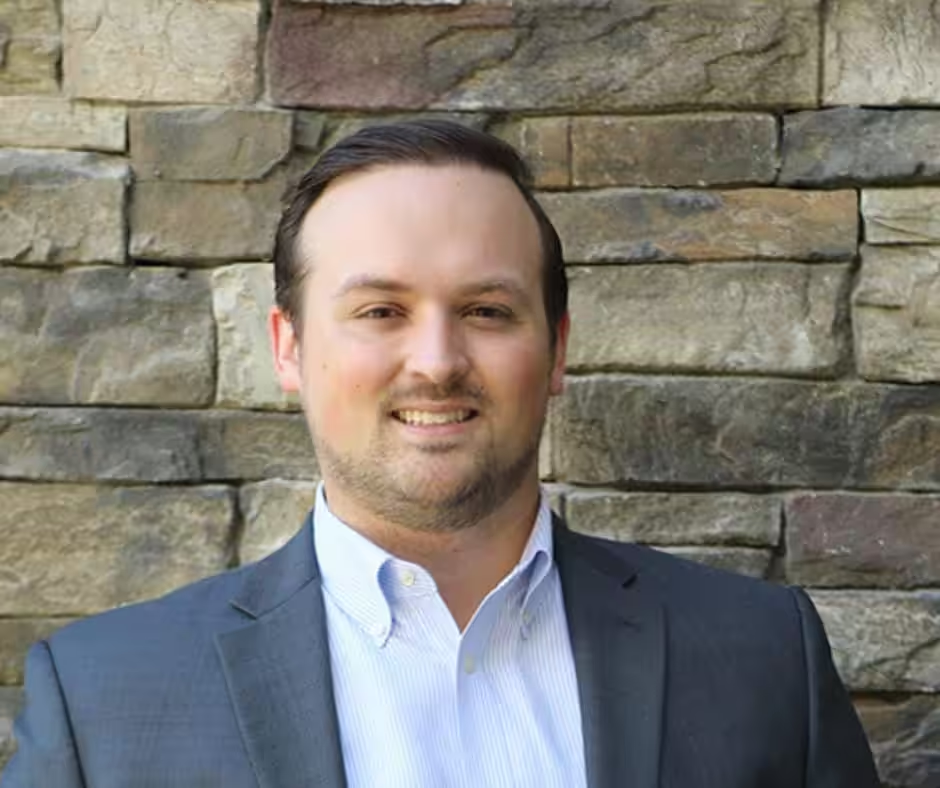
Ryan P. Duffy, Raleigh Estate Planning Attorney
Your Attorney

Ryan P. Duffy, Esq.

Founder • Estate Planning of the Carolinas • NC Licensed

Every Raleigh client gets Ryan personally — the same attorney from intake through drafting and signing. Estate Planning of the Carolinas exists to deliver that kind of attention to North Carolina households without requiring an office visit or hourly billing.

Licensed — North Carolina State Bar
Licensed — South Carolina State Bar
500+ estate plans completed
5.0 Google Rating • Verified Reviews
Remote Online Notarization Certified
Meet Ryan →
Common Questions

Estate planning FAQ for Raleigh, NC

TSERS (Teachers' and State Employees' Retirement System) and NC 401(k) Plan benefits pass to beneficiaries by designation — not through your will or trust. You must specifically name beneficiaries with the NC Retirement Systems and the NC 401(k) Plan administrator. Survivor benefit elections you make at retirement affect how much (if anything) flows to your spouse — those elections cannot be changed after retirement begins. Ryan reviews state employee retirement designations as part of every Raleigh state employee engagement and coordinates them with the will or trust.
RSUs (Restricted Stock Units) that have vested pass through your estate (will or trust). Unvested RSUs typically forfeit at death unless your equity plan provides otherwise — many tech companies have specific death/disability vesting accelerators that you need to know about. Pre-IPO equity at private RTP companies (Pendo, Epic Games before IPO, Bandwidth before IPO) requires liquidation/sale provisions that anticipate restricted transferability. Trust-based plans drafted by Ryan address these specific RTP scenarios.
Yes. TIAA/CREF accounts have different distribution rules than typical 401(k) plans — including annuity options, life income options, and beneficiary distribution provisions that affect how the account passes at death. Many academic clients are surprised to learn that TIAA Traditional annuity values cannot simply be paid out as a lump sum at death — the structure affects beneficiary planning. Ryan reviews TIAA/CREF beneficiary forms as part of academic client engagements.
Wake County is the second-busiest NC probate jurisdiction (after Mecklenburg), but the Wake County Justice Center is one of the most efficiently run probate offices in the state. Routine matters typically resolve in standard timelines — 10–14 months for a complete estate administration. The Wake County estate examiner process generally moves accountings through faster than counties without examiners, provided documentation is precise. Trust-based planning still avoids the Wake County probate process entirely.
North Carolina does not require in-person meetings to execute estate planning documents. Ryan handles every Raleigh engagement on Zoom, with signing under Remote Online Notarization. RON has been authorized in NC since 2022.
For renters with simple finances and no minor children, sometimes. For Raleigh households with a house, retirement accounts, life insurance, or kids, a will alone misses the incapacity question entirely — the durable power of attorney and healthcare power of attorney handle that. And if avoiding Wake probate matters, a funded living trust is the document that does the work.
Also Serving

Nearby North Carolina communities we serve

All-NC coverage, by Zoom. Other communities near Raleigh that Ryan works with regularly:

Ready to protect your Raleigh family?

A free intake call covers the planning questions specific to your household. No commitment, no office trip, no hourly billing.

Schedule Free Consultation → View Flat-Fee Pricing
Takes 2 minutes · No commitment · Serving all of North Carolina