Estate Planning Attorney in Waxhaw, NC
Union County estate planning, done online: wills, living trusts, healthcare directives, and powers of attorney — without the office visit.
Protecting your family starts with the right documents
Waxhaw families come to Estate Planning of the Carolinas for one reason: they want the planning done right, without the office visits and hourly bills that traditional NC firms still charge for. The work itself isn't mysterious. A will controls who inherits. A power of attorney lets a trusted person act if you can't. A healthcare power of attorney and living will put a known voice in the room when a hospital is asking who decides.
A revocable living trust comes in when Union County probate is worth bypassing — common for families with real estate, business interests, or privacy concerns. Without those documents in place, North Carolina intestate succession decides for you and Union County Clerk of Superior Court supervises the result, publicly, on the court's timeline.
Ryan drafts every plan personally, by Zoom, at a flat fee. Waxhaw clients sign under Remote Online Notarization without leaving home.
NC intestacy: Under N.C.G.S. Chapter 29 the surviving spouse does not automatically inherit everything in North Carolina — when there are children, the spouse shares with them under a statutory formula. The plan-by-default is almost never the plan the family would have chosen.
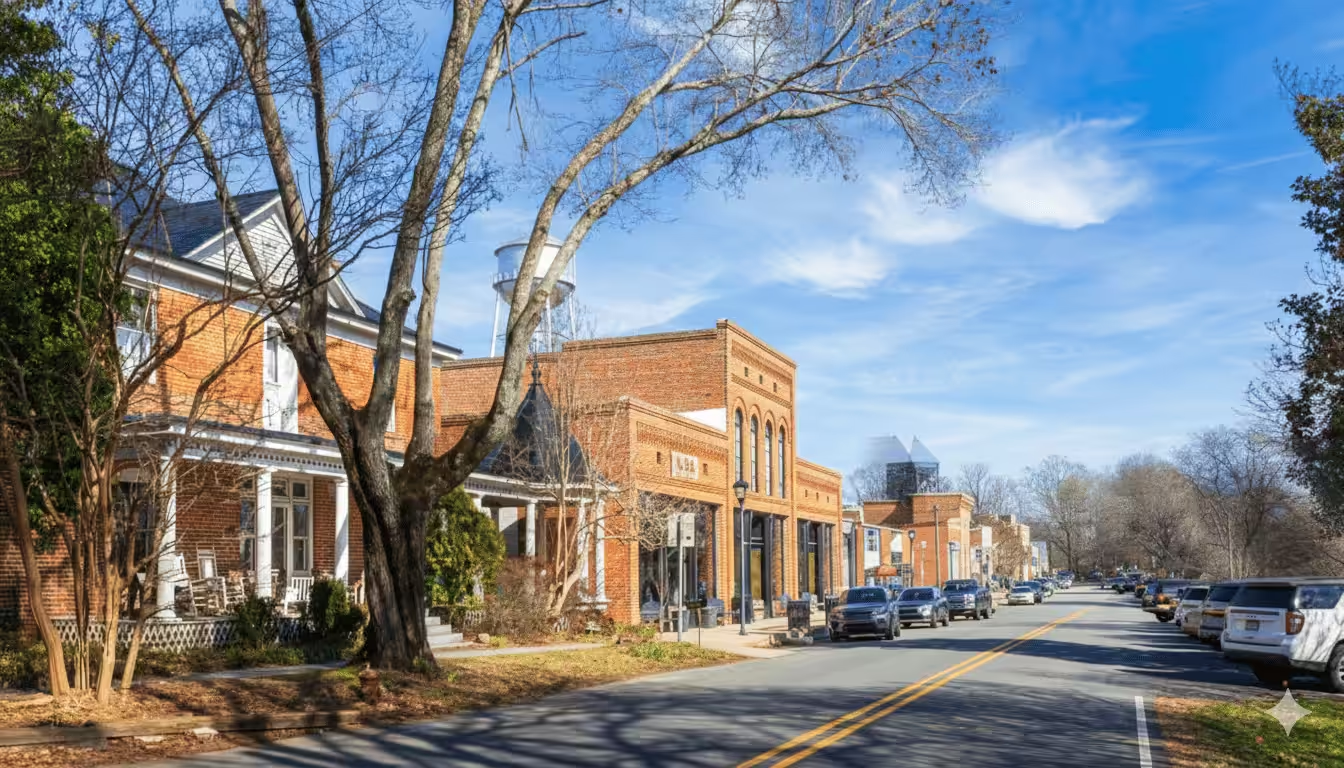
Estate planning for Waxhaw residents
Waxhaw is among the most affluent and fastest-growing suburbs in the Charlotte metro, sitting in southwest Union County on the SC border. Its rise has been driven by a combination of strong public schools (Union County Public Schools and several charter and private options), the historic small-town downtown, the proximity to Charlotte’s southern job centers (Ballantyne, SouthPark, and downtown via I-485), and the influx of higher-income executive and professional families seeking land, space, and schools.
The estate planning client base in Waxhaw is heavily weighted toward dual-income executive households, often with one spouse working in Charlotte’s banking, healthcare, or corporate sector and the other in a flexible or part-time role. Many clients have relocated from other parts of the country — the Northeast, the Midwest, and California — bringing existing trusts drafted under high-tax-state law, equity compensation, and substantial accumulated assets. Cross-border (NC-SC) considerations are common: many Waxhaw residents work in South Carolina (Fort Mill, Indian Land, Rock Hill) or own property there, creating coordination issues at death.
Union County is a notable contrast to Mecklenburg for probate purposes: lower volume, faster routine processing, and a more predictable court calendar. Even so, most Waxhaw estate planning clients pursue trust-based plans because of the typical asset profile — real estate, retirement accounts, equity, and frequently second residences — rather than because of any Union County probate friction.
Common situations we see in Waxhaw
No template handles every household. These patterns come up repeatedly in Waxhaw intakes — and each calls for specific drafting, not a generic form.
Waxhaw neighborhoods and communities
Ryan serves clients across Waxhaw and Union County — all virtually, with no office visit required.
North Carolina requirements every Waxhaw resident should know
Four North Carolina statutes drive most of a Waxhaw plan: N.C.G.S. § 31-3.3 (will execution — written, signed, two witnesses; holographic wills allowed but vulnerable), Chapter 32C (durable financial powers of attorney; agent owes a fiduciary duty), N.C.G.S. § 32A-15 and § 90-321 (healthcare power of attorney and living will), and Chapter 36C (the NC Uniform Trust Code, including spendthrift protection at § 36C-5-502).
Without a power of attorney, families end up in Union guardianship proceedings under N.C.G.S. § 35A-1201. Full citations and worked examples: North Carolina estate planning guide.
NC-SC Cross-Border Planning, Charlotte Executive Compensation, and Union County Probate Speed
Waxhaw’s planning landscape combines three distinct features: a high-income executive client base anchored to Charlotte employers, frequent NC-SC cross-border asset profiles, and the practical reality of Union County’s notably faster probate process compared to Mecklenburg. Each shapes how the plan is structured.
Charlotte Executive Compensation
Many Waxhaw clients work at Charlotte’s major employers — Bank of America, Wells Fargo, Truist, Duke Energy, Honeywell, Lowe’s, Atrium, Novant — with compensation packages that include base salary, performance bonus, RSUs, ESPPs, and deferred compensation plans. Each component has its own beneficiary or pass-through mechanic. Deferred compensation plans typically pass under the plan’s beneficiary form (not the will) and may have payout-acceleration rules at death. RSUs and ESPPs follow the grant-agreement rules. The estate plan does not override these mechanics but should coordinate them.
NC-SC Cross-Border Asset Coordination
Waxhaw sits on the SC border, and many households have SC ties: a spouse employed in Indian Land or Fort Mill, a second residence on Lake Wylie, family in Charleston or Hilton Head, or business interests in SC. NC and SC have meaningfully different probate procedures, different elective-share rules, and different trustee defaults. Real estate in both states held outside a trust triggers probate in each. Trust-based ownership of out-of-state real estate is the cleanest solution and is standard practice for NC-SC dual-asset families.
Union County Probate Speed
Union County is materially faster than Mecklenburg for routine estate administration — routine estates close in 6–10 months versus 12–18 for Mecklenburg. The clerk’s office in Monroe is well-staffed and responsive. This still does not eliminate the case for trust-based planning at higher asset levels (privacy, multi-state coordination, real estate handling), but it does reduce the urgency of probate avoidance for simpler estates.
Estate planning services for Waxhaw families
Every plan is customized to your family, your assets, and North Carolina law — never a one-size-fits-all template.
The foundation of every NC plan — asset distribution, guardian designations for minor children, and an executor you actually trust.
A revocable living trust that actually holds the deed and the brokerage accounts — the only structure that reliably skips Union County Clerk of Superior Court.
Durable power of attorney for finances + healthcare power of attorney — the two documents that prevent a court guardianship if you lose capacity.
End-of-life medical wishes documented so Waxhaw hospitals — and your family — know exactly what you want.
Flat-fee pricing for NC families: one number, paid once, all documents included.
Cryptocurrency, brokerage logins, business accounts, and digital assets — covered under NC law.
What happens without an estate plan in Waxhaw
Understanding the local probate process is one of the strongest reasons to plan ahead.
Probate is the court-supervised process of paying debts and transferring what the deceased owned. For Waxhaw estates without a trust, that means filing the will with Union County Clerk of Superior Court, qualifying an executor under N.C.G.S. Chapter 28A, publishing notice to creditors, inventorying assets, and submitting accountings before distribution. Timeline: 6–18 months, sometimes longer.
⚖ Union County Probate — Key Facts
- Court: Union County Clerk of Superior Court
- Address: 400 N Main St, Monroe, NC 28112
- Filing fee: Sliding scale under N.C.G.S. § 7A-307 — $120 floor, then a percentage of the estate value
- Process: Open the estate, file the 90-day inventory, run creditor notice, then submit the final account — the statutory walk-through under N.C.G.S. Chapter 28A
- How to avoid it: A funded revocable living trust is the primary workaround; joint ownership with right of survivorship and beneficiary designations handle specific assets
- Union County Clerk of Superior Court: 400 N Main St, Monroe NC — handles all Union County estate matters; about 15 miles east of Waxhaw
- Volume & Speed: Union County is faster than Mecklenburg — routine estates typically take 6–10 months
- NC-SC Border: Waxhaw sits on the SC border; many residents have SC employment, SC property, or SC family members — ancillary administration is common in border estates
- Equestrian & Land Holdings: Many Waxhaw residents hold significant acreage; the asset profile drives trust-based titling for non-probate transfer
A funded revocable trust avoids Union County Clerk of Superior Court entirely. Ryan drafts under North Carolina trust law — including the fiduciary standards at N.C.G.S. §§ 36C-8-802 and 36C-8-804 — and walks every Waxhaw client through funding, which is the step most lawyers skip and the only step that actually determines whether probate is avoided.
How Waxhaw families complete their estate plan
Three steps, roughly 2–3 weeks, no office visit.
Discovery Call
A free 30-minute Zoom that establishes the household assets, family structure, and goals — you leave with a clear scope and a quoted flat fee.
Drafting Phase
5–10 business days to produce NC-statute-compliant drafts of every document in your plan. Ryan does the drafting personally.
Remote Signing
A Zoom review, then RON signing with a commissioned NC electronic notary. The signed PDFs are the executed originals.
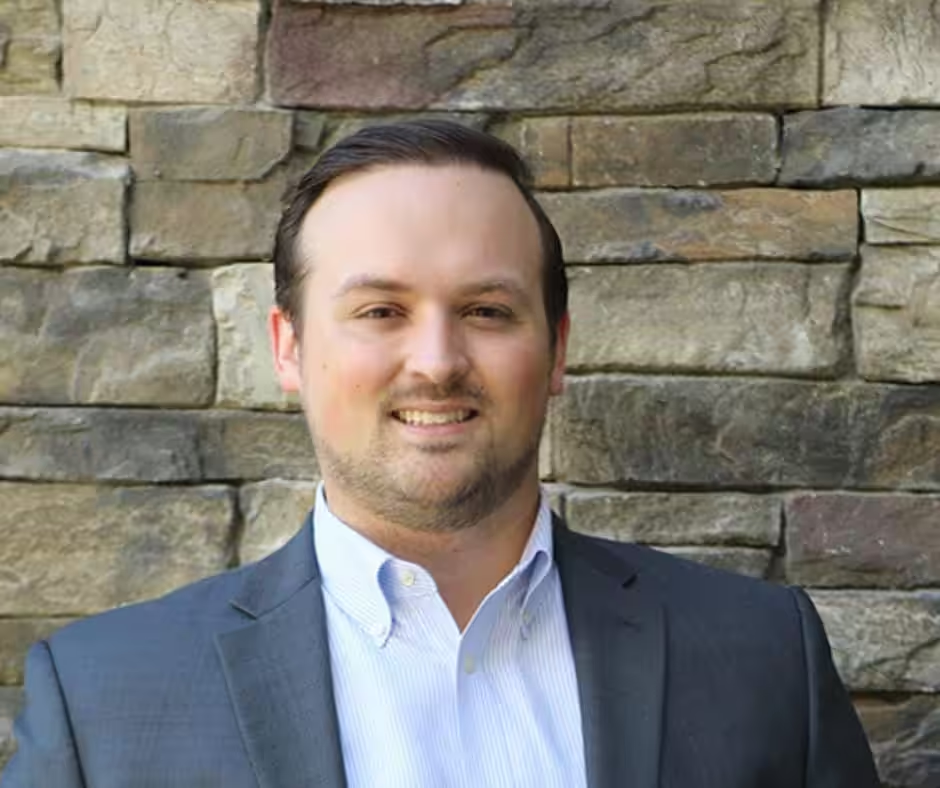
Ryan P. Duffy, Esq.
No paralegal queue, no associate ladder — Waxhaw clients work directly with Ryan, an NC-licensed estate planning attorney, on every step of the engagement.
Estate planning FAQ for Waxhaw, NC
North Carolina areas near Waxhaw
Estate Planning of the Carolinas works with families across North Carolina. A few communities near Waxhaw:
A Waxhaw estate plan, finished in three weeks
A free intake call covers the planning questions specific to your household. No commitment, no office trip, no hourly billing.