Estate Planning Attorney in Chapel Hill, NC
A complete NC estate plan for Chapel Hill households — drafted, reviewed, and signed remotely with Remote Online Notarization.
Protecting your family starts with the right documents
Chapel Hill families come to Estate Planning of the Carolinas for one reason: they want the planning done right, without the office visits and hourly bills that traditional NC firms still charge for. The work itself isn't mysterious. A will controls who inherits. A power of attorney lets a trusted person act if you can't. A healthcare power of attorney and living will put a known voice in the room when a hospital is asking who decides.
A revocable living trust comes in when Orange County probate is worth bypassing — common for families with real estate, business interests, or privacy concerns. Without those documents in place, North Carolina intestate succession decides for you and Orange County Clerk of Superior Court supervises the result, publicly, on the court's timeline.
Ryan drafts every plan personally, by Zoom, at a flat fee. Chapel Hill clients sign under Remote Online Notarization without leaving home.
NC intestacy: N.C.G.S. § 29-14 distributes an intestate estate by a fixed formula — in many Chapel Hill households the surviving spouse takes only the first $60,000 of personal property plus one-half of the remainder, with the rest passing to descendants. Unmarried partners take nothing.
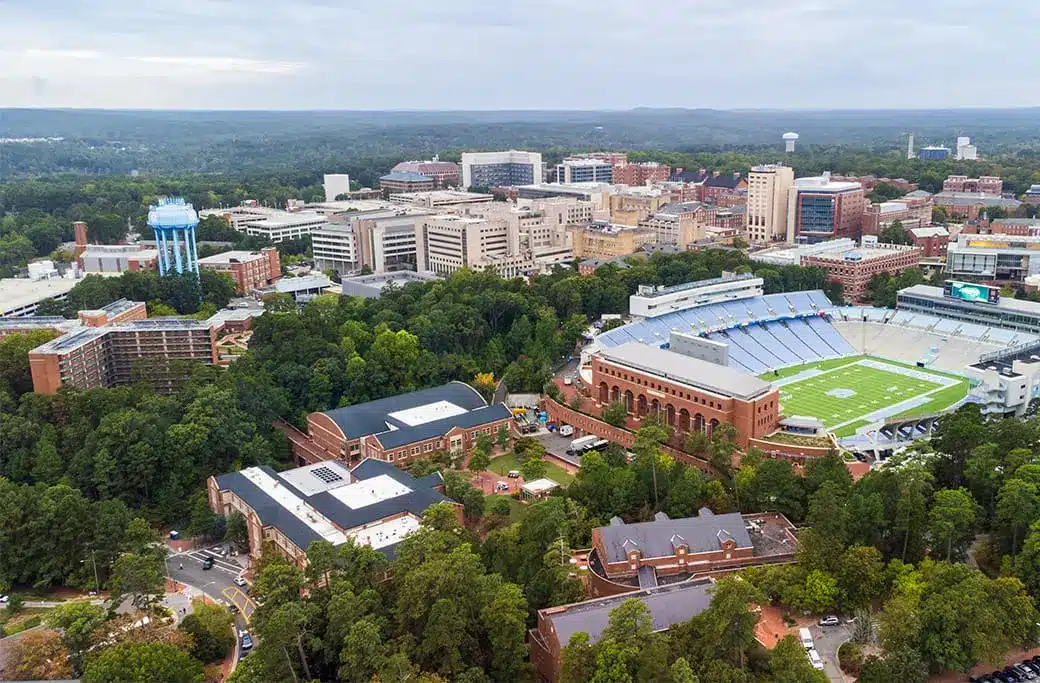
Estate planning for Chapel Hill residents
Chapel Hill is dominated by the University of North Carolina at Chapel Hill — North Carolina's flagship university — and the UNC Health system. The estate planning client base reflects this: UNC faculty and staff at every career stage, UNC Health physicians and researchers, academic families with multi-generational Chapel Hill ties, and the substantial retiree population drawn to Chapel Hill for the cultural and intellectual environment. Orange County (which includes Carrboro, Hillsborough, and other surrounding communities) has its own probate jurisdiction.
Chapel Hill estate planning needs cluster around academic specifics: UNC retirement plans (TIAA/CREF for many faculty, NC ORP for others, TSERS for some staff), academic IP and royalty interests, sabbatical-related compensation, and tenure-related deferred income. UNC Health physicians often have substantial retirement accounts and practice equity considerations. The retiree population (often academic or academic-adjacent) frequently has charitable inclinations toward UNC, Duke, or local nonprofits — making charitable planning common.
Common situations we see in Chapel Hill
No template handles every household. These patterns come up repeatedly in Chapel Hill intakes — and each calls for specific drafting, not a generic form.
Chapel Hill neighborhoods and communities
Ryan serves clients across Chapel Hill and Orange County — all virtually, with no office visit required.
North Carolina requirements every Chapel Hill resident should know
North Carolina recognizes attested wills under N.C.G.S. § 31-3.3 (in writing, signed, two witnesses) and holographic wills, though holographic wills are easier to contest. A self-proving affidavit under N.C.G.S. § 31-11.6 lets the Orange clerk admit the will without later witness testimony. Powers of attorney follow the NC Uniform Power of Attorney Act (Chapter 32C); healthcare directives follow the Natural Death Act (N.C.G.S. Chapter 90). Revocable living trusts are governed by the NC Uniform Trust Code (Chapter 36C) and bypass Orange County Clerk of Superior Court if properly funded.
For citations and the full statutory framework, see the North Carolina estate planning guide.
UNC Faculty, TIAA Accounts, and Multi-State Academic Family Planning
Chapel Hill’s estate planning needs are shaped by an academic workforce that retires later, accumulates more in tax-deferred retirement accounts than in any other asset class, and frequently holds property or family ties in two or three states. The University of North Carolina at Chapel Hill, UNC Health, and the affiliated research economy produce a faculty and physician population for whom the standard will-trust-power-of-attorney package needs meaningful customization.
TIAA, Defined-Contribution Accounts, and the SECURE Act
A long-tenured UNC professor or physician often holds the bulk of household wealth in TIAA-CREF and the UNC Optional Retirement Program, supplemented by 403(b) and 457(b) plans. Two planning issues recur:
- The 10-year rule for non-spouse beneficiaries. Under the SECURE Act (codified at IRC § 401(a)(9)(H)), most adult children inheriting a parent’s retirement account must withdraw the entire balance within ten years of the account owner’s death. For a faculty member with a $2–3 million TIAA balance, this can push children into the highest marginal federal bracket for a decade. A conduit trust or accumulation trust under N.C.G.S. § 36C-1-103 can be structured to qualify as a “see-through” trust under Treasury Regulation § 1.401(a)(9)-4, but the drafting must be exact.
- TIAA Traditional annuity contracts. Unlike a typical IRA, TIAA Traditional can only be distributed over a nine-year period (the “Transfer Payout Annuity”) or as a lifetime annuity. Beneficiary designations must align with the form of distribution actually permitted by the contract, or the executor will discover at death that the named trust cannot receive the asset on the schedule the will assumed.
NIL, Athletics, and Academic IP
Two newer issues affect Chapel Hill households. The first is NIL income earned by student-athletes, much of it routed through LLCs the student forms during enrollment. These entities frequently have no operating agreement, no successor planning, and no clear separation between the student’s NIL revenue and family contributions. The second is faculty intellectual property — patents, royalty streams from textbooks, software copyrights, and consulting interests in spinout companies. UNC’s patent policy reserves certain rights to the University, but residual royalty streams flow to the inventor and become probate assets unless titled in a trust.
Multi-State Coordination
Many Chapel Hill academics maintain a primary residence in Orange County, a vacation home or family property in another state (Vermont, Massachusetts, and Florida are common), and adult children scattered across additional jurisdictions. North Carolina probate of a will containing out-of-state real property triggers ancillary probate in the situs state. Two structural fixes:
- Revocable trusts holding all real property, avoiding ancillary probate entirely. North Carolina recognizes a revocable trust under N.C.G.S. § 36C-6-602 as the functional equivalent of a will for this purpose.
- Coordinated domicile planning for retirees who plan to move to Florida, which has no state income tax. A premature move can subject the entire IRA distribution stream to North Carolina income tax under N.C.G.S. § 105-153.4 if domicile is not properly established.
Estate planning services for Chapel Hill families
Every plan is customized to your family, your assets, and North Carolina law — never a one-size-fits-all template.
Will drafting under NC law — structured to clear the Orange clerk's admission process and survive a will contest.
Probate avoidance for Chapel Hill families — private, fast transfers without court supervision, when the trust is properly funded.
Durable financial and healthcare powers of attorney drafted under NC law. The single most-used documents in any estate plan.
Statutory advance directive recognized at every Chapel Hill-area hospital and care facility. Drafted in plain language.
Transparent flat fees for Chapel Hill households — quoted before any work begins, no hourly billing.
Crypto, online accounts, intellectual property — the assets the standard form will doesn't address.
What happens without an estate plan in Chapel Hill
Understanding the local probate process is one of the strongest reasons to plan ahead.
Probate is the court-supervised process of paying debts and transferring what the deceased owned. For Chapel Hill estates without a trust, that means filing the will with Orange County Clerk of Superior Court, qualifying an executor under N.C.G.S. Chapter 28A, publishing notice to creditors, inventorying assets, and submitting accountings before distribution. Timeline: 6–18 months, sometimes longer.
⚖ Orange County Probate — Key Facts
- Court: Orange County Clerk of Superior Court
- Address: 106 E Margaret Ln, Hillsborough, NC 27278
- Filing fee: Sliding scale under N.C.G.S. § 7A-307 — $120 floor, then a percentage of the estate value
- Process: Personal representative appointment, inventory filing, creditor notice (3 months), and final accounting — all under N.C.G.S. Chapter 28A
- How to avoid it: A funded revocable trust avoids the whole process; beneficiary designations and TOD deeds handle pieces individually if a trust is overkill for the situation
- Orange County Clerk of Superior Court: 106 E Margaret Ln, Hillsborough — handles all Orange County estate matters including Chapel Hill and Carrboro; located in Hillsborough (about 12 miles from Chapel Hill)
- Processing Time: Orange County probate runs at a moderate pace — routine estate administration typically takes 10–14 months
- UNC Retirement Coordination: Many Chapel Hill estates involve UNC retirement plans (TIAA/CREF, NC ORP) that pass by beneficiary designation rather than through probate
Trust-based planning is the standard Chapel Hill workaround for Orange County Clerk of Superior Court. Compliant drafting under the NC Uniform Trust Code (Chapter 36C) is necessary but not sufficient — the trust must actually be funded with real estate, accounts, and beneficiary designations. Ryan handles both pieces of the work.
How Chapel Hill families complete their estate plan
Three steps, roughly 2–3 weeks, no office visit.
Discovery Call
A free 30-minute Zoom that establishes the household assets, family structure, and goals — you leave with a clear scope and a quoted flat fee.
Plan Build-Out
Drafts of every document — will, durable POA, healthcare POA, living will, trust if needed — built specifically for the situation discussed on the intake call.
Execution
A second Zoom: review, witness, and sign under RON. The recording and the tamper-evident PDF are the signed originals.
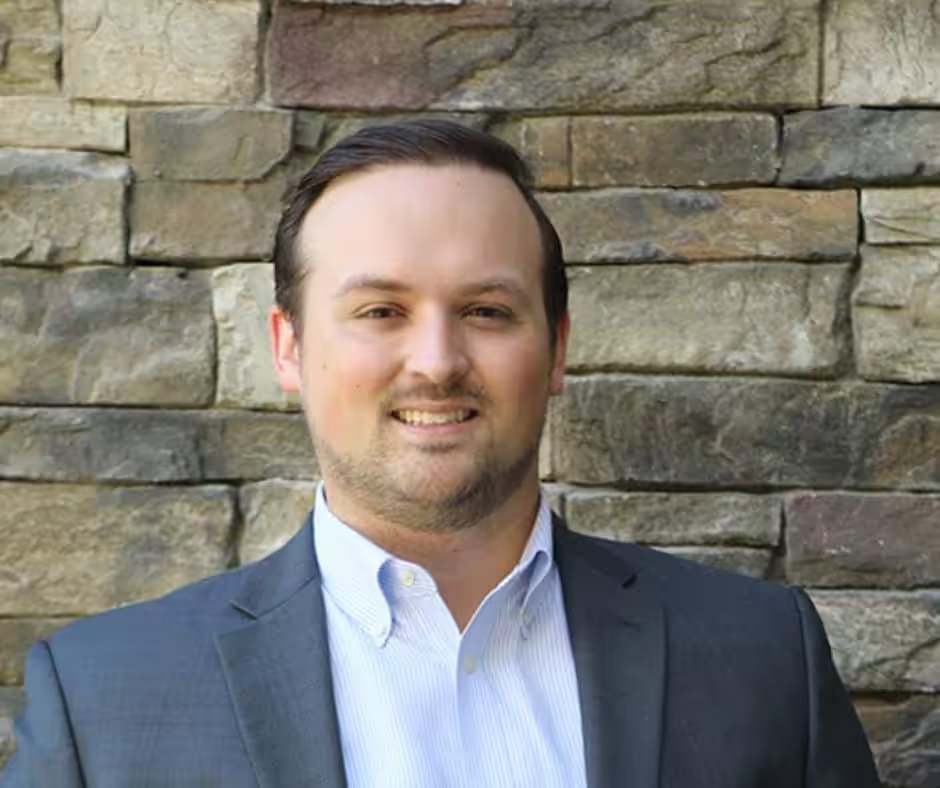
Ryan P. Duffy, Esq.
Every Chapel Hill client gets Ryan personally — the same attorney from intake through drafting and signing. Estate Planning of the Carolinas exists to deliver that kind of attention to North Carolina households without requiring an office visit or hourly billing.
Estate planning FAQ for Chapel Hill, NC
Other North Carolina communities Ryan works with
The practice is statewide and entirely remote. These communities are within easy reach of Chapel Hill.
Ready to protect your Chapel Hill family?
Start with a free 30-minute consultation. No office visit, no hourly billing — clear guidance from a licensed North Carolina estate planning attorney.