Estate Planning Attorney in Indian Trail, NC
Union County estate planning, done online: wills, living trusts, healthcare directives, and powers of attorney — without the office visit.
Protecting your family starts with the right documents
Indian Trail families come to Estate Planning of the Carolinas for one reason: they want the planning done right, without the office visits and hourly bills that traditional NC firms still charge for. The work itself isn't mysterious. A will controls who inherits. A power of attorney lets a trusted person act if you can't. A healthcare power of attorney and living will put a known voice in the room when a hospital is asking who decides.
A revocable living trust comes in when Union County probate is worth bypassing — common for families with real estate, business interests, or privacy concerns. Without those documents in place, North Carolina intestate succession decides for you and Union County Clerk of Superior Court supervises the result, publicly, on the court's timeline.
Ryan drafts every plan personally, by Zoom, at a flat fee. Indian Trail clients sign under Remote Online Notarization without leaving home.
NC intestacy: NC intestacy under N.C.G.S. Chapter 29 splits the estate by a fixed share table — spouse plus children share; the spouse does not take everything. Unmarried partners and informal heirs inherit nothing regardless of intent.
Estate planning for Indian Trail residents
Indian Trail is one of the fastest-growing towns in Union County and has tripled in population since 2000. It sits along the US-74 corridor between Matthews (Mecklenburg County) and Monroe (the Union County seat), making it a natural choice for working families who want Charlotte-area employment access without Mecklenburg-area housing prices. The town is more middle-class and blue-collar in profile than nearby Waxhaw or Weddington — reflecting a broader cross-section of skilled trades, healthcare workers, public-sector employees, and corporate-services professionals.
The estate planning client base in Indian Trail is dominated by working and middle-class families with the foundational planning needs: a will with guardian designations for minor children, durable powers of attorney, healthcare powers of attorney, and a HIPAA authorization. Many clients are first-time planners triggered by a life event — new baby, parent’s death, real estate purchase, or a job change with a new retirement plan. Trust-based plans are common but not universal; many Indian Trail households use a will-based plan with carefully coordinated beneficiary designations on retirement accounts and life insurance.
Union County’s probate process is meaningfully faster than Mecklenburg’s — routine estates typically close in 6–10 months versus 12–18 in Mecklenburg. That makes will-based plans relatively more viable in Indian Trail than they would be for a comparable family in Mint Hill or Matthews, where Mecklenburg probate friction is a stronger driver toward trust-based planning.
Common situations we see in Indian Trail
No template handles every household. These patterns come up repeatedly in Indian Trail intakes — and each calls for specific drafting, not a generic form.
Indian Trail neighborhoods and communities
Ryan serves clients across Indian Trail and Union County — all virtually, with no office visit required.
North Carolina requirements every Indian Trail resident should know
Indian Trail residents work with four legal frameworks: NC will law (N.C.G.S. Chapter 31; two witnesses or a self-proving affidavit at § 31-11.6), NC powers of attorney (Chapter 32C), the NC Healthcare Power of Attorney and Natural Death Act (Chapter 32A and N.C.G.S. § 90-321), and the NC Uniform Trust Code (Chapter 36C). A funded revocable trust avoids Union County Clerk of Superior Court entirely; an unfunded one does not, which is the single most common drafting failure we see.
Deeper statutory walk-through: North Carolina estate planning guide.
Foundational Planning, Beneficiary Coordination, and Union County Probate for Indian Trail Families
Indian Trail’s estate planning needs are shaped by a working- and middle-class client base, frequent first-time planners, and the practical reality that Union County’s probate process is fast enough that probate avoidance is not always the dominant planning driver. The framework most Indian Trail clients need is foundational, well-coordinated, and proportionate to their asset levels.
The Foundational Document Set
For most Indian Trail households, the core package is a will (with guardian designations for minor children, if applicable), a durable financial power of attorney, a healthcare power of attorney with HIPAA authorization, and a living will. Each document serves a specific purpose: the will directs probate-asset distribution and nominates a guardian, the financial POA covers incapacity during life, the healthcare POA names a medical decision-maker, and the living will addresses end-of-life decisions. These four documents are the baseline for any adult.
Beneficiary Coordination Across Accounts
Retirement accounts (401(k), IRA, Roth IRA), life insurance policies, and annuities pass by beneficiary designation outside the will. For most Indian Trail families, these beneficiary-designated assets represent more than half of the estate by value. Coordinating these designations with the will is essential. Common errors: naming minor children directly (which forces a guardianship of the property), failing to name contingent beneficiaries, naming an ex-spouse (forgotten after divorce), and inconsistencies between the will’s intent and the beneficiary form. Reviewing every beneficiary designation at the time the will is signed prevents most of these issues.
When a Trust Is and Is Not Worth It
For working-class and middle-class Indian Trail clients with one home, one retirement account each, and minor children, a will-based plan with proper beneficiary coordination usually suffices. Union County probate is fast enough that probate-avoidance alone is not a compelling reason to add a trust. The case for a trust strengthens when there is out-of-state real estate, a blended family with children from prior relationships, a desire for privacy (probate is public), or a need to control distributions to children at staged ages. The honest answer is often: a trust is helpful but not essential at your asset level.
Estate planning services for Indian Trail families
Every plan is customized to your family, your assets, and North Carolina law — never a one-size-fits-all template.
Your core NC will — updated for the household assets and family structure you actually have, not a generic template.
A funded revocable trust under NC law moves real estate, accounts, and business interests to heirs without Union probate supervision.
Two short documents that prevent a Union guardianship or conservatorship case if you lose capacity.
A living will under NC law gives a binding answer when no one in the room knows what you would have chosen.
Document bundles or full plans — Indian Trail clients see the full cost before signing the engagement letter.
Specific provisions for digital assets so executors can actually access accounts under the North Carolina Revised Uniform Fiduciary Access to Digital Assets Act.
What happens without an estate plan in Indian Trail
Understanding the local probate process is one of the strongest reasons to plan ahead.
In Indian Trail the probate process is what most people imagine when they hear "estate": the will gets filed with Union County Clerk of Superior Court, an executor qualifies, creditors get notice (N.C.G.S. § 28A-14-1), and the executor inventories and accounts for everything before heirs receive anything. Public, slow, and exactly the thing a properly funded revocable trust is designed to skip.
⚖ Union County Probate — Key Facts
- Court: Union County Clerk of Superior Court
- Address: 400 N Main St, Monroe, NC 28112
- Filing fee: A $120 floor plus a percentage of estate value (N.C.G.S. § 7A-307), payable to the clerk
- Process: Chapter 28A controls: qualification of an executor or administrator, asset inventory within 90 days, statutory creditor notice, then a final accounting
- How to avoid it: Funded revocable trust for the estate as a whole; TOD/POD beneficiary designations for accounts; joint-with-right-of-survivorship for jointly used property
- Union County Clerk of Superior Court: 400 N Main St, Monroe NC — handles all Union County estates; about 8 miles east of Indian Trail
- Volume & Speed: Routine Union County probate runs 6–10 months — notably faster than Mecklenburg
- Will-Based Plans Viable: The faster probate process makes will-based plans relatively more practical for middle-income Indian Trail households
- Mecklenburg Border: Indian Trail abuts the Mecklenburg County line; some residents work in Mecklenburg but file estates in Union based on domicile
A funded revocable trust avoids Union County Clerk of Superior Court entirely. Ryan drafts under North Carolina trust law — including the fiduciary standards at N.C.G.S. §§ 36C-8-802 and 36C-8-804 — and walks every Indian Trail client through funding, which is the step most lawyers skip and the only step that actually determines whether probate is avoided.
How Indian Trail families complete their estate plan
Three steps, roughly 2–3 weeks, no office visit.
Intake Call (Free)
A short Zoom call to understand the household, the assets, and the goals. You leave with a clear recommendation and a fixed quote.
Documents Prepared
A working draft of every document the plan requires, drafted under North Carolina law and ready for review on Zoom.
Review and Sign
Walk through the documents on Zoom, then execute under Remote Online Notarization — statutorily valid in North Carolina.
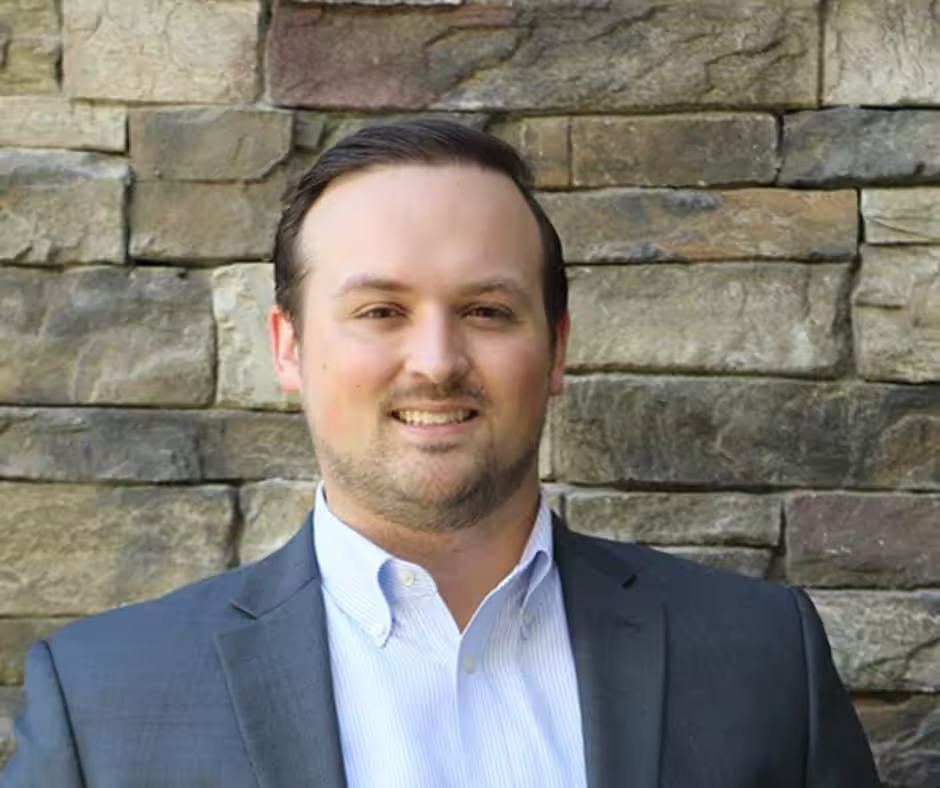
Ryan P. Duffy, Esq.
Every Indian Trail client gets Ryan personally — the same attorney from intake through drafting and signing. Estate Planning of the Carolinas exists to deliver that kind of attention to North Carolina households without requiring an office visit or hourly billing.
Estate planning FAQ for Indian Trail, NC
Adjacent North Carolina communities
All-NC coverage, by Zoom. Other communities near Indian Trail that Ryan works with regularly:
Ready to protect your Indian Trail family?
Book a free 30-minute Zoom call. Flat-fee quote, no obligation, NC-licensed counsel.