Estate Planning Attorney in Myrtle Beach, SC
Horry County estate planning, done online: wills, living trusts, healthcare directives, and powers of attorney — without the office visit.
Protecting your family starts with the right documents
Estate planning for Myrtle Beach households is less about templates and more about three questions: who inherits, who acts for you if you can't, and whether Horry County probate is worth avoiding. A do-nothing default answers all three with South Carolina intestacy — a fixed statutory formula that rarely matches what families actually want.
For most Myrtle Beach clients the working set is a will, a durable financial power of attorney, a healthcare power of attorney with a living will, and (when there's real estate, a blended family, or young children) a revocable living trust. Beneficiary forms on retirement accounts and life insurance are coordinated alongside — otherwise the will and the beneficiary form contradict each other.
Ryan handles every Myrtle Beach engagement personally, on Zoom, on a flat fee quoted before any work starts. No paralegals, no associates, no in-person trips.
SC intestacy: Dying without a will in Myrtle Beach triggers SC Code § 62-2-101 et seq. — a fixed-share formula that splits the estate between spouse and descendants and excludes unmarried partners entirely.

Estate planning for Myrtle Beach residents
Myrtle Beach anchors the Grand Strand — the 60-mile stretch of coastal SC that runs from Little River to Pawleys Island and supports one of the largest tourism economies in the Southeast. The estate planning client base in Myrtle Beach reflects three distinct populations: retirees who relocated for the climate, golf, and lower cost of living relative to comparable coastal destinations; hospitality and tourism workers whose livelihoods are tied to the seasonal economy; and Myrtle Beach Air Force Base veterans and active military connected to nearby installations (and broader DoD ties through the regional defense workforce).
The retiree segment dominates the estate planning conversation, but with a different profile than Hilton Head Island or Bluffton: lower median asset levels, more frequent single-source income (Social Security, modest pensions, IRA), and more variability in residential type (oceanfront condos, golf-community homes, inland subdivisions). The relocator wave comes heavily from the Carolinas’ own neighbors (NC, VA, OH, PA, NY, WV) and the tax-driven migration from high-tax northeastern states.
Horry County handles all Myrtle Beach estate matters from the county seat in Conway, about 15 miles inland. South Carolina’s Title 62 probate code applies, with its 8-month creditor notice period and formal filing requirements. Tourism-property issues are common: vacation rental management, oceanfront condo HOAs, timeshare interests, and ancillary administration coordination for out-of-state owners. Ryan handles Myrtle Beach engagements with attention to these specifics.
Common situations we see in Myrtle Beach
No template handles every household. These patterns come up repeatedly in Myrtle Beach intakes — and each calls for specific drafting, not a generic form.
Myrtle Beach neighborhoods and communities
Ryan serves clients across Myrtle Beach and Horry County — all virtually, with no office visit required.
South Carolina requirements every Myrtle Beach resident should know
Myrtle Beach planning works under four SC frameworks: will execution under S.C. Code § 62-2-502 (no handwritten/unwitnessed wills), the SC Uniform Power of Attorney Act (§§ 62-8-101 et seq.; notary plus two witnesses), the Healthcare Power of Attorney and Death with Dignity Act (§§ 44-77-10 et seq.; the two witnesses cannot be related to you or share in your estate), and the SC Uniform Trust Code (Title 62, Chapter 7).
Without a financial power of attorney, family members petition Horry County Probate Court for a conservatorship — expensive and slow. Full statute references: South Carolina estate planning guide.
Coastal Property Planning, Military Benefits, and Horry County Probate
Myrtle Beach’s estate planning landscape is built around three forces: a steady inbound retiree migration drawn by climate, golf, and tax advantages; a significant share of coastal and tourism property held by non-SC owners; and a meaningful military-and-veteran population tied to the regional defense ecosystem. Each shapes the structure of the plan.
Coastal Property and Ancillary Probate Avoidance
A meaningful share of Myrtle Beach real estate is owned by non-SC residents — oceanfront condos, vacation rentals, second homes, and timeshare interests. SC-situs real property requires SC ancillary probate at the owner’s death if held in individual name, even if the primary estate is administered in another state. Trust-based ownership eliminates this entirely. For the typical non-resident property owner, the cost of transferring the property into a revocable trust is small compared to the avoided ancillary administration cost and delay.
Military and Federal Benefits Coordination
Myrtle Beach has a substantial veteran and military-retiree population, and SC’s exclusion of military retirement income from state tax makes it a deliberate destination for retiring service members. The estate plan should coordinate with each federal benefit program: SBP elections (irrevocable in most cases), TSP beneficiary designations, FEGLI insurance, SGLI for active duty, and VA-administered benefits. The will does not override these designations — the federal program rules do.
SC Retirement Tax Treatment and Domicile
SC offers retirees a $15,000 retirement income deduction for those 65+ under S.C. Code § 12-6-1170, no state estate tax, and favorable treatment of military retirement income. Capturing these benefits requires establishing and documenting SC domicile — particularly for clients who maintain a residence in another state. Voter registration, driver’s license, vehicle registration, the 4% primary residence assessment under S.C. Code § 12-43-220(c), and the location of financial advisors all weigh in the analysis.
Estate planning services for Myrtle Beach families
Every plan is customized to your family, your assets, and South Carolina law — never a one-size-fits-all template.
A South Carolina-valid will covering distribution, executor appointment, and (for parents) guardianship for minor children. The non-negotiable starting point.
For Myrtle Beach households with real estate, blended families, or privacy needs — transfers without court involvement.
Durable financial and healthcare powers of attorney drafted under SC law. The single most-used documents in any estate plan.
End-of-life medical wishes documented so Myrtle Beach hospitals — and your family — know exactly what you want.
Document bundles or full plans — Myrtle Beach clients see the full cost before signing the engagement letter.
Cryptocurrency, brokerage logins, business accounts, and digital assets — covered under SC law.
What happens without an estate plan in Myrtle Beach
Understanding the local probate process is one of the strongest reasons to plan ahead.
Every Myrtle Beach estate without a fully funded trust runs through Horry County Probate Court. The named personal representative opens the estate under S.C. Code § 62-3-301, publishes notice to creditors under § 62-3-801, inventories assets, and obtains court approval for distribution. The process is public — anyone can read the file — and takes 6–18 months in most cases.
⚖ Horry County Probate — Key Facts
- Court: Horry County Probate Court
- Address: 1301 2nd Ave, Conway, SC 29526
- Filing fee: Determined by estate value under S.C. Code § 62-3-720
- Process: SC Uniform Probate Code (Title 62): qualify a personal representative, inventory, creditor notice under § 62-3-801, final accounting
- How to avoid it: A funded revocable trust; beneficiary designations on retirement, life insurance, and POD/TOD bank accounts; joint tenancy with right of survivorship
- Horry County Probate Court: 1301 2nd Ave, Conway SC — handles all Horry County estates; about 15 miles inland from Myrtle Beach proper
- Volume & Speed: Routine Horry County probate typically takes 10–14 months — comparable to other mid-size SC counties
- Tourism Property: Many estates include vacation rental properties, oceanfront condos, or timeshare interests with HOA, management, and ancillary considerations
- Out-of-State Ancillary: Non-resident decedents owning SC property require ancillary administration in Horry County unless held in trust
Trust-based planning is the standard Myrtle Beach workaround for Horry County Probate Court. Compliant drafting under the SC Uniform Trust Code (Title 62, Chapter 7) is necessary but not sufficient — the trust must actually be funded with real estate, accounts, and beneficiary designations. Ryan handles both pieces of the work.
How Myrtle Beach families complete their estate plan
Most clients finish their entire SC estate plan in 2–3 weeks — without leaving home.
Free Zoom Consultation
30–60 minutes by video. We cover assets, family structure, and the documents that actually fit — no pitch deck, no upsell.
Documents Drafted
Customized will, trust, and powers of attorney — compliant with South Carolina law and matched to the family situation, not a generic form.
Final Signing
A final Zoom review, witnesses and notary present electronically, signed under SC's RON statute. Originals delivered as tamper-evident PDFs.
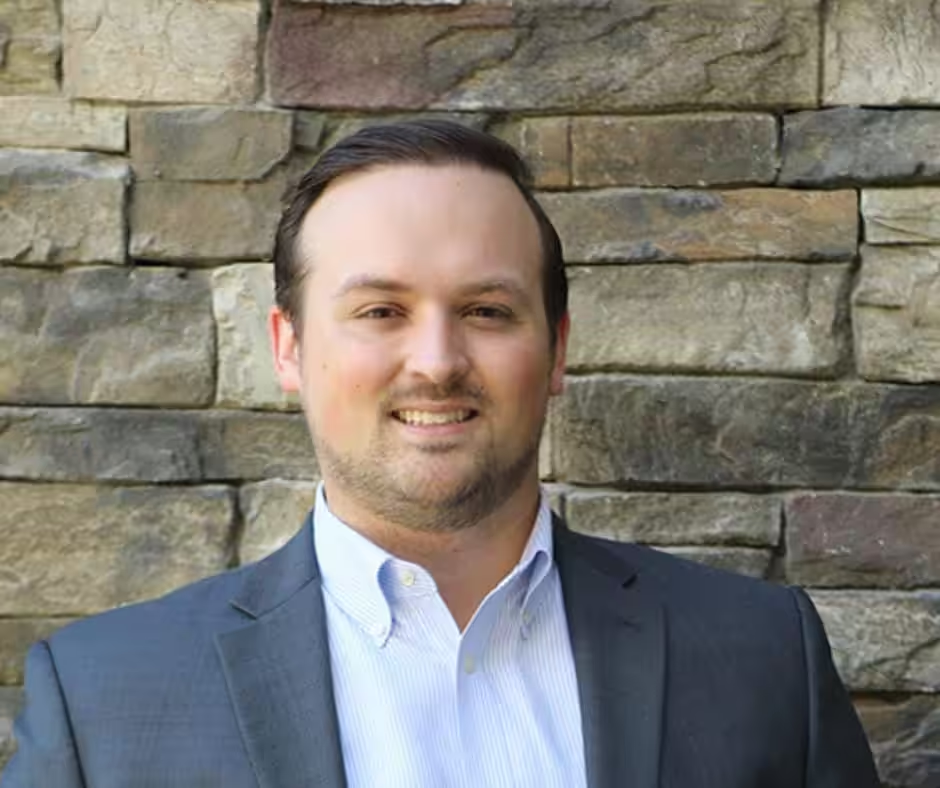
Ryan P. Duffy, Esq.
Every Myrtle Beach client gets Ryan personally — the same attorney from intake through drafting and signing. Estate Planning of the Carolinas exists to deliver that kind of attention to South Carolina households without requiring an office visit or hourly billing.
Estate planning FAQ for Myrtle Beach, SC
Nearby South Carolina communities we serve
The practice is statewide and entirely remote. These communities are within easy reach of Myrtle Beach.
Make the plan official — from your Myrtle Beach living room
A free intake call covers the planning questions specific to your household. No commitment, no office trip, no hourly billing.